

🎯 Electrical safety before home automation!!
I will be honest with you: I have long been afraid to touch my electrical circuits. A few years ago, when I wanted to change a socket, I neglected to check whether the circuit breaker was properly cut.
Result: an unpleasant ⚡ discharge that shook me well and reminded me that electricity does not forgive. Since that day, before each intervention, I have become paranoid.

And that’s exactly why I have the Kaiweets KTL01, a non-contact voltage tester that prevents me from reliving this moment.
On this blog, I test a lot of Zigbee equipment, sensors and home automation modules. But before installing them, you often have to touch electricity. Here is my full feedback after several weeks of use.
⚡ Why this tester in my home automation toolbox
After my chestnut, I changed the way I worked.
No more trusting the circuit breaker alone.
I need to systematically check that there is no tension before touching a wire.
Whether it is to install a Zigbee jack, a Sonoff module, a siren or a sensor, I always start by checking that the circuit is off.
The Kaiweets KTL01 offers me this security: it detects the presence of an electric field linked to an alternative voltage, without contact, directly through the cable insulation.
And the icing on the cake: it makes it possible to compare the intensity of the signal between phase and neutral, which helps me with wiring. No more the stress of wondering if I cut the right circuit.
🏢 Who is Kaiweets?

Kaiweets is a Chinese brand specialising in electrical measuring devices and tools for both professionals and private individuals.
The brand says it was created in 2018. However, the first legal traces I found date back to 2019, when Shenzhen Xinsuicheng Trading Co., Ltd., a company that owns Kaiweets brands and markets the products on different platforms, was founded in Shenzhen.
For the KTL01, the manual designates as manufacturer Shenzhen Wanhe Innovation Technology Co., Ltd., also installed in Bao’an District in Shenzhen. The tester is marked "Made in China". However, it is necessary to remain precise: the documentation identifies Kaiweets as a manufacturer, but it is not clear whether the plant is owned directly by Kaiweets or whether it is an industrial partner in charge of production.
Kaiweets also has a contact office in Hong Kong under the name KAIWEETS Technology Limited.
For Europe, the mark indicates that it relies on local stocks to shorten delivery times, but it does not publish the precise address of its European warehouse. The Manual of the KTL01 also mentions CET Product Service Sp. z o.o. in Poland as the European representative. It is a regulatory relay for the European Union, not necessarily a distributor or an after-sales service.
On the commercial side, Kaiweets sells directly on its site and also goes through platforms such as Amazon, TikTok Shop or ManoMano. The brand is also looking for wholesalers and distributors and runs an affiliate programme. We are therefore facing a recent Chinese brand, mainly focused on international e-commerce, with declared manufacturing in Shenzhen and logistics and regulatory relays in Europe.
🔍 Why I chose the KTL01 from the Kaiweets
Kaiweets offers several voltage testers, each with its own specificities. Here is a precise comparison of the models I have identified:
| Model | Type | Detection | NCV Beach | Dual-range | Phase/neutral | Screen | Security |
|---|---|---|---|---|---|---|---|
| KTL01 | NCV Pen Tester | Contactless | 12-1000V AC | Yes (12-1000V / 70-1000V) | Yes (by intensity) | Color LCD % + bar | CAT IV 1000V |
| HT100S | NCV Pen Tester | Contactless | 12-1000V AC | Yes (12-1000V / 70-1000V) | Yes (by intensity) | LCD % + bar | CAT III 1000V / CAT IV 600V |
| HT100 | NCV Pen Tester | Contactless | 12-1000V AC | Yes (12-1000V / 48-1000V) | Yes (by intensity) | LCD + bar | CAT III 1000V / CAT IV 600V |
| VT200 | NCV Pen Tester | Contactless | 12-1000V AC | Yes | Yes (by intensity) | LED Bars | CAT III 1000V / CAT IV 600V |
| KTS01 | Screwdriver Tester | Contact + NCV | 3-300V AC | No | Yes (by intensity) | LCD indicator | Not specified |
| KTS02 | Screwdriver Tester | Contact + NCV | 3-300V AC | No | Yes (by intensity) | LCD indicator | Not specified |
| ST100 | Smart Multimeter Pen | Contact + NCV | 12-1000V AC | No | Yes (by intensity) | LCD 4000 counts | CAT III 600V |
My choice of KTL01 It focused on a number of criteria:
- CAT IV 1000V : the KTL01 offers the highest safety in the range, unlike the HT100S (CAT III 1000V / CAT IV 600V) and ST100 (CAT III 600V)
- Phase/neutral indication by intensity : like other NCV models, it allows to compare the signal intensity between phase and neutral, crucial for my home automation installations
- Informative Color LCD Screen : percentage + graphic bar + colours, more readable than the LEDs of the VT200 or the single screen of the HT100
- Dual-range (12-1000V / 70-1000V) : versatility to avoid false positives near transformers, absent on the ST100
- Compact pen format : fits in the pocket, practical clip, more discreet than a complete multimeter like the ST100
- Built-in flashlight : practical for darkboards, absent on KTS01/KTS02
- Auto stop 5 minutes : better compromise than 3 minutes (HT100, VT200) or 15 minutes (ST100)
The ST100 tempted me with its precise AC/DC measurements (up to 600V) and its multimeter functions (resistance, capacity, frequency, diode, phase sequence), but for my use (check no voltage before intervention), the KTL01 I'm more than enough.
The KTS01/KTS02 are test screwdrivers, practical but limited in range (3-300V) and without dual-range.
The HT100S is very similar to the KTL01, but with slightly lower safety (CAT III 1000V / CAT IV 600V).
The VT200 has an LED display that is too basic for my use.
The KTL01 therefore offers the best compromise security/features/price.
🔍 I check the received model

- On the carton : reference KTL01 perfectly visible
- Type of equipment : Non-contact voltage tester (NCV) with phase/neutral indication by signal intensity
- Protocol : Passive Electromagnetic Detection
- Power supply : 2 x 1.5V AAA batteries (to be installed, supplied)
- Detection ranges : 12-1000V AC (High Sensitivity), 70-1000V AC (Low Sensitivity)
- Dimensions / IP : pen size, pocket clip, CAT IV 1000V
🛒 Where to buy the Kaiweets KTL01?
Here is the link to the page dedicated to KTL01.
I referenced the sellers and prices.
📦 Unpacking and First Impressions
At the reception, I unpack everything: tester KTL01, 2 AAA batteries, multilingual leaflet.

The case is compact, fits in one hand.
The LCD screen is well protected by a film.
My impression: solid finish, reactive buttons, sturdy clip for the pocket.
🔧 Powering on: I install the batteries
Batteries are not pre-installed. I'm unscrewing the back cover of the tester. I place the two supplied AAA batteries respecting the polarity (+ and -).
I'm back on the hood.
I press the red button: the screen lights up with backlight.
I test the SENS button to switch between High Sensitivity (12-1000V) and Low Sensitivity (70-1000V).
The integrated LED lamp is activated with the dedicated button (centre).

Automatic shutdown occurs after 5 minutes without use.
First test on a socket of the show: immediate beep, red screen. Perfect, it works at this point.
🏡 My security ritual before every home automation installation
Before touching a thread, I now have an immutable ritual.
First, I switch off the general circuit breaker or the circuit breaker concerned.

Then I take my KTL01 in my pocket.
I activate it in high sensitivity (12-1000V).
I pass the tip near the wire to be stripped, the socket to be changed, the module to be installed.
If the screen remains green and silent: This is a good sign, but I remain cautious.
If it beeps and turns red: I'm going back, I'm going to check my circuit breaker again.
This ritual, I do systematically now. It takes 10 seconds, but it prevents me from being discharged again.
Attention: an absent signal does not prove the absence of voltage. The KTL01 may not detect some conductors (blinded, in metal sheath, too far away, etc.).
I therefore do not consider it to be a voltage-free tester (VAT) in the regulatory sense.
⚡ Differentiate phase and neutral: assistance in locating
A feature I tested: comparison of the signal strength between phase and neutral.
The manual indicates that the phase wire usually produces a stronger signal than the neutral. To perform this test, I can even test it in nothing to disassemble, facing each hole in a socket.
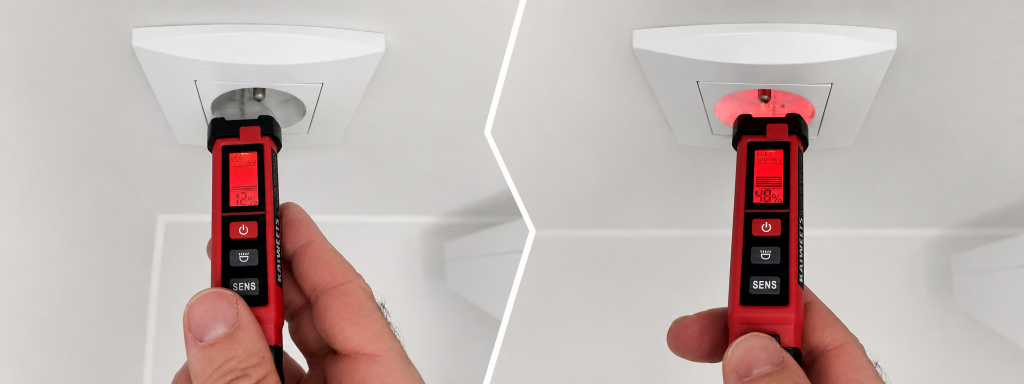
I compare the percentage displayed and the bar graph.
The hole that generates the most intense signal is usually the phase (right here), while the neutral produces a weaker signal.
On the phase, the % varies between 40 and 60% on one socket and neutral between 5% and 15%.
I notice that the tester does not blink and sound the same way.
This indication, however, depends on the distance between the tester and the driver, the insulation, the arrangement of the wires and the structure of the socket.
A good old tester screwdriver can confirm the phase but you have to touch the copper.
🔎 Follow a driver: a possibility to be checked
The signal of the KTL01 evolves when I move the tester along a driver.
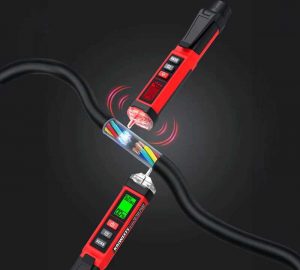
This observation may be interesting to follow an accessible cable, but it does not allow to conclude with certainty that a break is at the point where the signal disappears.
A decrease in signal may be caused by distance, thickness of insulation, metal sheath, shielding or the position of my hand.
To really look for a break, you have to use a suitable device, for example a continuity tester or a cable locator.
⚙ My tips for use
- High sensitivity : for 120V/240V domestic circuits, wide detection, this is my main use
- Low sensitivity : near transformers, grouped circuit breakers, to avoid interference
- LED lamp : very useful in dark paintings or poorly lit basements
- Pocket clip : I always keep it on me, like a screwdriver
- Auto Stop : saving batteries, but turning it off manually after each use
- Systematic testing : always test on a known power socket before intervention
- Phase/neutral : compare signal strength, not automatic identification
🔍 What communities say and tests online
Positive points noted:
- Reliable detection from 12V in High Sensitivity
- LCD screen with percentage and very readable graphic bar
- CAT IV 1000V, EN61010-1 compliant for safety
- Compact, practical clip, appreciated LED lamp
- Excellent value for money (~20-25€)
- Signal intensity phase/neutral indication
Limits indicated:
- Low sensitivity (70-1000V) can miss very low voltages
- Possible false positives near transformers or bundled cables
- Multilingual notice but not always very detailed
My personal tips after several weeks:
- Always test on a known power outlet before you start
- Keep the KTL01 in the pocket with the clip, always at hand
- Never trust only the circuit breaker: always check with the tester
- Use signal comparison for my socket wiring and luminaires
- Take it out before each home automation installation: Zigbee, module, plug, etc.
💬 My opinion after several weeks of use
✅ Strengths:
- Reliable and fast NCV detection on 120V/240V home
- Clear LCD screen with percentage + graphic bar + colors (red/green)
- Dual-range (12-1000V / 70-1000V) very practical according to context
- Signal intensity phase/neutral indication, useful for wiring
- Compact pen size, pocket clip, built-in LED lamp
- CAT IV 1000V safety, the highest in the Kaiweets range
- Price accessible for these features (~20-25€)
- Reassures me before each intervention, ends the paranoia
- Perfect complement to my home automation toolbox
- Best compromise security/features/price in the Kaiweets range
❌ Weaknesses:
- Low sensitivity not very useful below 70V (thermostats, doorbells)
- Some false positives near transformers or bundled cables
- Notice could be more detailed on borderline cases
My verdict: The Kaiweets KTL01 became my inseparable companion for all my electrical and home automation interventions.
After my bad experience, he gave me the psychological security I needed.
Its informative LCD display, its reliable detection and its ability to compare the intensity of the signal between phase and neutral make it a tool that I always keep in my pocket.
For ~€20-25, this is the best compromise in the Kaiweets range for regular home automation use, especially thanks to its CAT IV 1000V certification.
I highly recommend it to all Domotic handymen, especially those who have already taken a "chestnut" like me.
It is well worth it to sleep quietly before touching a wire, a Zigbee socket or a Sonoff module.
📊 Full technical data sheet
| Characteristic | Specification |
|---|---|
| Model | Kaiweets KTL01 |
| Type | Non-contact voltage tester (NCV) with phase/neutral intensity indication |
| Detection range | 12-1000V AC (High Sensitivity), 70-1000V AC (Low Sensitivity) |
| Frequency | 50-60 Hz |
| Security | CAT IV 1000V, double insulation, IEC 61010-1 compliant |
| Power supply | 2 x 1.5V AAA batteries (to be installed) |
| Automatic shutdown | Yes, after 5 minutes |
| Low battery indicator | Yes, 2.5V < alert, 2.3V auto < shutdown |
| Screen | Backlit LCD with percentage + graphic bar |
| Alerts | Sound (buzzer) + visual (red/green LED) |
| LED lamp | Yes, dedicated button |
| Phase/neutral indication | Yes, by comparison of signal strength |
| Operating temperature | -10°C to 50°C |
| Dimensions | Pen size, ~150mm x 30mm |
| Weight | ~80g with batteries |
| Colour | Orange and black |
| Warranty | 36 months (according to seller) |
 English
  French
  Spanish
  Chinese
  German