

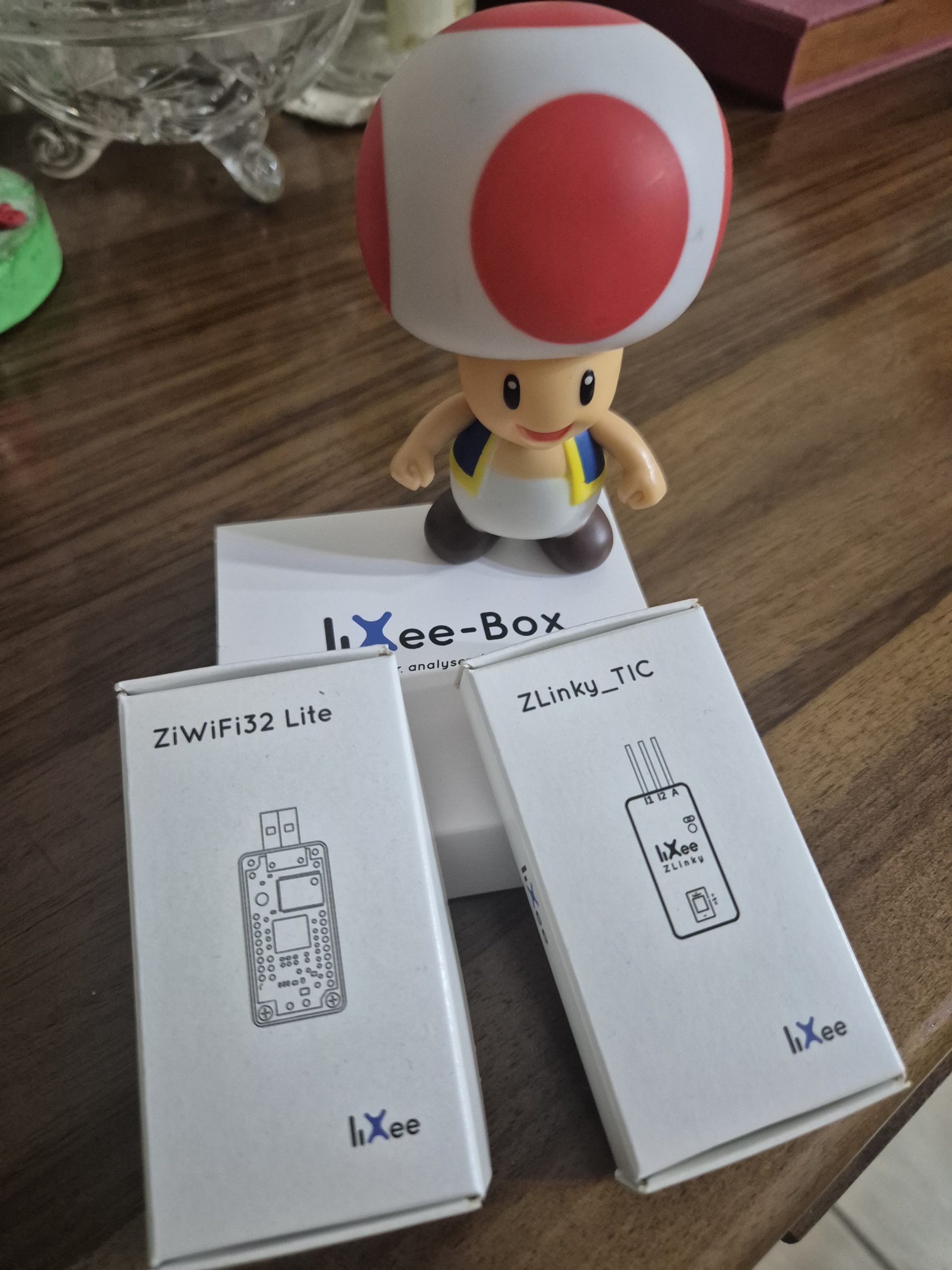
What is a LiXee-Box?
The LiXee-Box is an open-source home automation solution designed for monitoring and local management of energy consumption at home. Unlike many market solutions, it does not depend on an external cloud: All data stays on your home network, ensuring total privacy and optimal responsiveness.
This box usually consists of a main module, the ZiWiFi32 Lite, which acts as a central hub, and complementary modules such as the ZlinkyTIC, dedicated to the recovery of data from the Linky counter. It allows real-time measurement of electricity, water and gas consumption (with additional modules, ZiPulses for example), and offers advanced functionalities such as automation, smart load shedding and integration with other home automation systems.
Its open-source firmware and compatibility with open protocols such as MQTT make it a flexible solution, suitable for both beginners and advanced users. The LiXee-Box is ideal for those who want to control their energy consumption while maintaining full control over their data.
Contents of the LiXee-Box
As soon as I received my LiXee-Box, I started by examining the included material:
- 1 ZiWiFi32 Lite : the heart of the box, which manages communication and automation.
- 1 ZlinkyTIC: a Zigbee module to retrieve data from the Linky counter.
On the back of the box, I found QR codes giving quick access to official documentation, configuration tools and software updates. These QR codes are very practical for a quick start, especially for beginners in home automation.

Where to buy this equipment?
Here is the link to his page dedicated to the LiXee-Box. I referenced the sellers and prices.
Getting started and hardware installation
I started by plugging in the ZiWiFi32 Lite in the USB port of my PC on Windows 11. A notification sound sounded, confirming the detection of the device. Although no window opened automatically, I checked in the device manager: a new line USB Serial Converter appeared, indicating that the module was well recognized by my system.


I also noticed that a new port COM3 had been added, which will eventually allow the firmware to be flashed if necessary. I left the ZiWiFi32 Lite connected so that it remains powered throughout the configuration procedure.

Configuring the software with LiXee-Assist
I downloaded and installed the application LiXee-Assist on my smartphone. Available for free on Android and iOS, this application is essential to configure the LiXee-Box, flash the firmware and access advanced settings. It also makes it possible to visualize consumption data in real time and to control connected devices.
After launching the application, I started searching for the LiXee-Box on my local network via mDNS. After some testing, the connection was successfully established.


The mDNS search can sometimes take several attempts, but it ended up detecting my box.
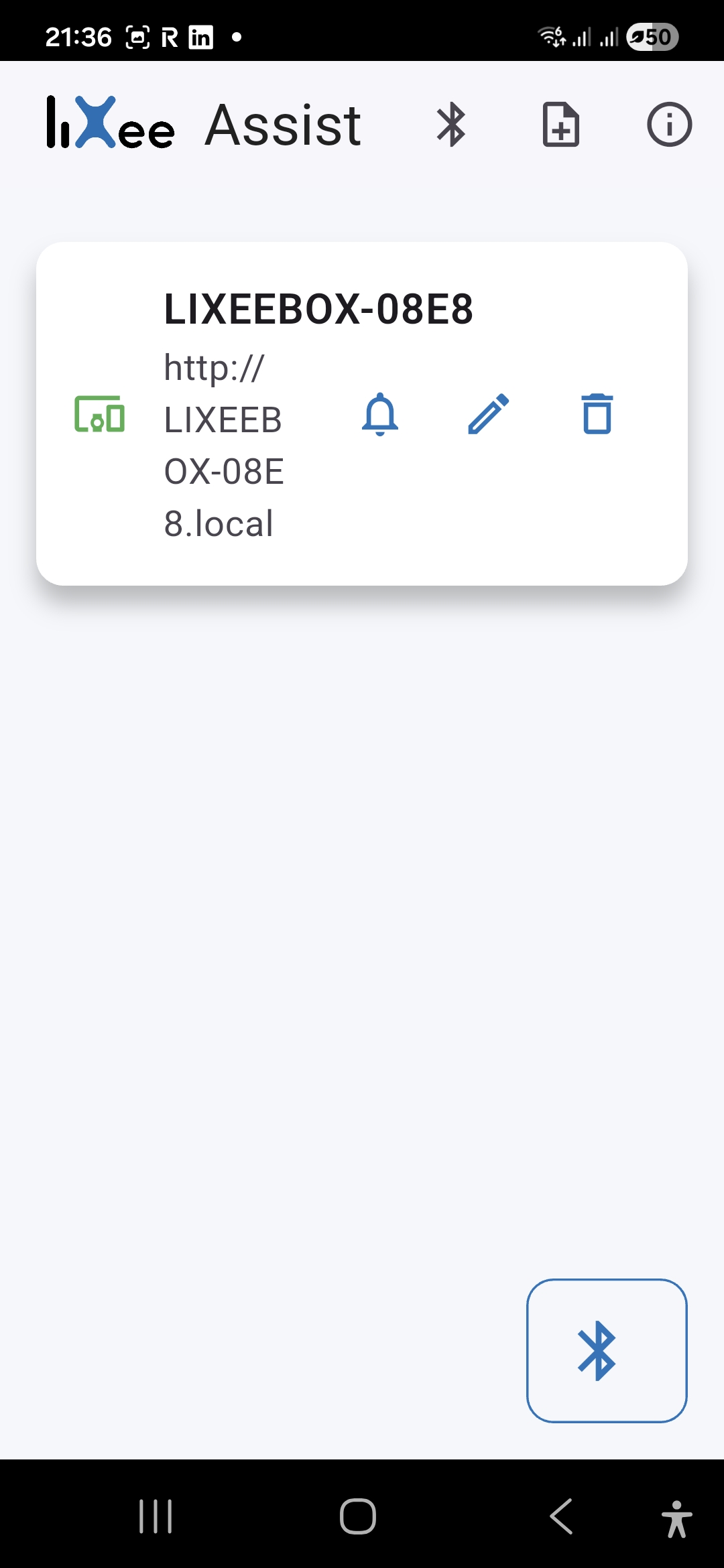
Firmware update
From the first connection, the interface offered me a firmware update. I decided to install it immediately to benefit from the latest features and bug fixes. The procedure was simple and took only a few minutes.

Once the update was complete, the version number at the bottom of the screen had changed, confirming that everything had gone well.

To make sure everything was working properly, I pinged ZiWiFi32 from my PC. The response was immediate, and I got his local IP address.

Connecting the ZLinky _TIC for electrical monitoring
The LiXee-Box guided me step by step to connect the ZLinky _TIC, a Zigbee module that allows you to recover data from my Linky counter. I plugged the ZLinky _TIC directly into the ICT port of my meter, and it started flashing, indicating that it was in pairing mode.

After a few seconds, the ZiWiFi32 Lite and ZLinky _TIC paired automatically. I was able to access my power consumption, instant power, and many other data directly from the app in real time.

The interface displays all consumption information, including power curves and histories.

This installation took me only a few minutes, everything is extremely simple.
I will stop my tests here, I will test another configuration of the ZiWiFi32 Lite, in gateway mode to make the link between the Zigbee and Wifi
Indeed, I already have a Zlinky _TIC installed in production for more than a year, here is my dedicated feedback:
Further explanations:
Why the LiXee-Box is a totally autonomous and local solution
What I immediately liked about the LiXee-Box is that it works entirely local, without relying on an external cloud. All consumption data, settings and automations remain on my home network. This guarantees a total confidentiality my energy data, without risk of leakage or exploitation by third parties.
The web interface of the LiXee-Box can be accessed directly from my browser, without the need to connect to a remote server. Even the mobile app LiXee-Assist communicates only with my box locally, via my Wi-Fi network. This means that I remain in control of my data and do not have to worry about privacy issues or paid subscriptions.
In addition, the LiXee-Box is based on a firmware open-source, which means that the community can audit the code, propose improvements and ensure that there is no backdoor or hidden data collection. This is a guarantee of transparency and security that few home automation solutions offer.
Discover the advanced features of the LiXee-Box
1. Multi-energy monitoring: electricity, water and gas
Although the ZLinky _TIC or mainly dedicated to electrical monitoring, the LiXee-Box can also manage water and gas consumption thanks to the module ZiPulses (sold separately). This Zigbee sensor connects to Gazpar meters or water meters equipped with an impulse output. It makes it possible to measure each litre or m³ consumed and to display the data in the unified dashboard of the box. This gives me a complete picture of my household’s energy consumption, making it easier to detect leaks or overconsumption.
With these sensors, the LiXee-Box becomes a real energy hub, capable of centralising and analysing all consumption data.
2. Zigbee Device Management
The LiXee-Box includes a Zigbee coordinator, which allows it to manage a wide range of connected devices: bulbs, smart plugs, temperature, humidity, motion sensors, etc. It is compatible with many devices on the market, including those from brands such as Xiaomi, Philips Hue, or IKEA. The addition of a new device is done directly from the web interface or mobile application, without the need for an additional home automation box.
Once paired, these devices can be individually controlled or integrated into automated scenarios. For example, I can program the ignition of the lights according to the presence or ambient brightness.
3. Energy Scoreboard and data analysis
The web interface of the LiXee-Box offers a Complete Energy Scoreboard, accessible from any browser. Here I find:
- Of dynamic gauges indicating the instantaneous power consumed, compared to the subscribed power.
- Of historical charts to analyse consumption trends over different periods (time, day, month, year).
- Of cost indicators in real time, calculated on the basis of full/off-peak rates.
- Of Customizable alerts to be notified in the event of exceeding the threshold or abnormal consumption.
These tools allow me to better understand my consumption habits and identify sources of waste.
4. Local automation and intelligent load shedding
The LiXee-Box does not merely measure and analyse: it can also acting to optimise energy management. Here are some examples of actions I can configure:
- Automatic shedding : If the power consumed exceeds the power subscribed, the box can temporarily cut some non-essential appliances (such as my water heater or a supplementary heater) to avoid disconnecting.
- Rules-based automation : I can configure scenarios to trigger actions based on specific criteria. For example, turn off a connected outlet if the consumption exceeds a certain threshold for a given period of time.
- Management of energy tariffs : The box can automatically adjust the operation of the devices according to full hours / off hours rates, to achieve savings.
- Alerts and notifications : In the event of water leakage, overconsumption or anomaly, the LiXee-Box can send me a notification alert or even cut a solenoid valve to limit the damage.
All these features are managed locally, without relying on an external cloud, which ensures the confidentiality of my data and optimal responsiveness.
5. Possible integration with other home automation boxes
Although the LiXee-Box is designed to operate autonomously, it can also engage with other home automation systems through open protocols such as MQTT. This allows me to easily integrate it into platforms like https://www.jeedom.com, Home Assistant, or Domoticz if I wish.
For example, with Home Assistant, the LiXee-Box can track all its data (power consumption, sensor status, etc.) and receive commands to trigger more complex scenarios. This interoperability makes it a flexible solution, suitable for both beginners and advanced users.
The box also supports the mechanisms of MQTT Discovery, This greatly simplifies its integration: Sensors and actuators are automatically detected and configured in Home Assistant, without manual intervention.
6. Over-The-Air (OTA) Updates
The LiXee-Box supports updates OTA (Over-The-Air) for the firmware of the box itself, but also for connected Zigbee devices. This allows me to keep the whole system up to date, without complex manipulation.
Updates are regular and often bring new features, such as compatibility with new sensors or performance improvements.
Why choose the LiXee-Box?
The LiXee-Box is distinguished by several major assets that have caught my attention:
- Solution 100% Local and autonomous : No dependency on an external cloud, all my data stays at home.
- Open-source and transparent : The code is accessible and auditable by the community, ensuring no hidden data collection.
- Modular and evolutionary : I can add sensors (electricity, water, gas) and Zigbee devices over time, depending on my needs.
- Intuitive interface : The dashboard is designed to be accessible to beginners, while offering advanced features for experienced users.
- Active community : The project is supported by a community of developers and users who regularly contribute to its improvement.
- Economic : Compared to other home automation solutions, the LiXee-Box offers excellent value for money, especially considering its many functionalities.
My final opinion on the LiXee-Box
The LiXee-Box is a solution open-source, autonomous and modular which allows me to measure, analyze and optimize my energy consumption in complete confidentiality. Its installation is simple, and its intuitive interface allows me to quickly take control of my data.
Whether it is to monitor my consumption, detect anomalies, automate actions or even integrate it into an existing home automation ecosystem, the LiXee-Box proves to be a valuable tool for intelligent and privacy-friendly energy management.
In autonomous mode, it advantageously replaces a dedicated home automation box for energy monitoring needs. But thanks to its compatibility with MQTT and other open protocols, it can also integrate perfectly with more complex installations if I so wish.
The fact that the designer has grouped a ZiWiFi32 Lite and a ZLinky _TIC in a very cheap LiXee-Box is a great idea and allows everyone to get started simply.
 English
 French
 Spanish
 Chinese
 German