

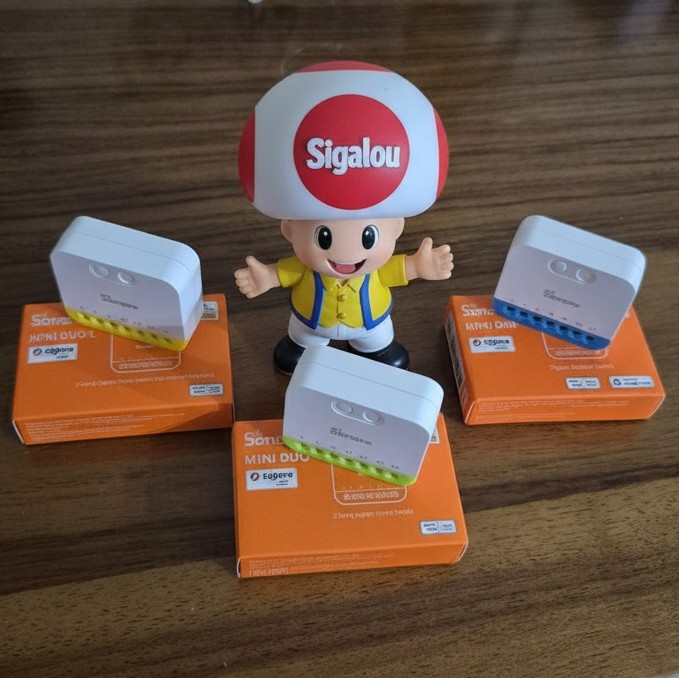
Today, I am taking you on a step-by-step journey through the latest Sonoff Zigbee series of modules released at the end of 2025. What are these “Sonoff Zigbee modules”? Let me explain everything from the beginning, as if we were sitting around a table with a coffee.
Imagine: you have a banal wall switch that turns on your living room lamp. With one of these modules, this switch becomes intelligent. You can turn it on from your smartphone, say ‘Alexa, turn off the kitchen’, or program ‘turn off auto after 5 minutes if forgotten’. No cables everywhere, no WiFi that trains: it is Zigbee, a special home automation radio super stable (like WiFi but dedicated, ranged 10 to 30 meters per module, and it automatically extends into ‘mesh’ – each module relays the signal of others, like a chain of friends passing the word).
These modules are small electronic boxes (39 mm long, 45 mm wide, 17 mm thick). You're the ones hide behind your existing switch, without changing the visible button or redoing the electricity. They cost between 15 and 25 euros each, are screwed in 10 minutes (two screws, phase/black wire + neutral/blue or not depending on the model), and work with Home Assistant (HA, free software on a mini-PC or Raspberry Pi that centralizes your entire smart home).
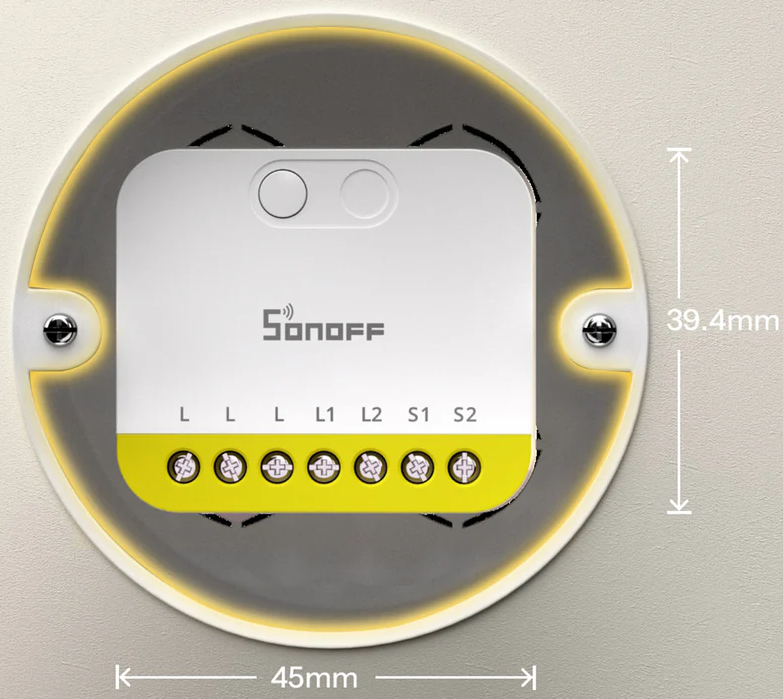
The range released at the end of 2025 counts three flagship models :

MINI-ZB2GS (also called ZB2GS or MINI DUO): The powerful dual switch, which requires the neutral wire.

MINI-ZB2GS-L (ZB2GS-L or MINI DUO-L): Same thing but without Neutral thread – perfect for old apartments from the 70s without this blue thread.

MINI-ZBDIM (ZBDIM or MINI Extreme Dimmer): The light dimmer with integrated electricity meter.
I checked on Zigbee2MQTT.io (the bible site listing ALL devices compatible with the free Z2M software for HA) and the official Sonoff website: no other products have been forgotten in this “new range”. These three cover 100% current needs: Dual switches (to control two lights or devices separately from a single housing), with or without neutral, plus the dimmer for soft environments.
I start with a lap: The comparative table
Now that I've laid the groundwork, I'm showing you a comparative table. This table is like a product sheet: it summarizes the essential differences so that you choose without getting lost.
| Model | Channels (how many independent circuits?) | Neutral required? (blue wire in your electric box) | Max charge (power supported, as bulbs/ventilos) | Flagship functions (making them unique) | Z2M/HA compatible? (home automation software) |
|---|---|---|---|---|---|
| ZB2GS (MINI DUO) The "big brother" with neutral |
2 Like two switches in one box |
Yes Mandatory blue thread (recent houses) |
16A total (10A/channel) ~3500W to 230V 5 LED spots + small radiator |
Powerful on/off relays + Repeater Zigbee (amplifies radio signal) + Turbo mode (range +++) |
Yes, excellent ZHA or Z2M |
| ZB2GS-L (MINI DUO-L) The Savior of Ancient Apartments |
2 Ditto, two circuits |
No! Only phase (brown/black thread) |
12A total ~2700W (300W/LED channel) Heating bathroom + garland |
On/off without neutral + Edge/pulse (detection push buttons) + Anti-scintillating LED |
Yes, perfect |
| ZBDIM (MINI Extreme) The smart dimmer with counter |
1 A single dimmer circuit |
Yes Mandatory blue wire |
Dimming up to 3000W LEDs, halogens, CFL |
Intensity Variator + Conso measurement (watts/volts/live amps) + Accuracy Calibration |
Yes, top |
Small quick lexicon for this table:
- Amperes (A) : Electrical current ‘force’ measurement (such as water pipe thickness).
- Watts (W) : Actual power (energy consumed).
- Repeater Zigbee : Each module acts as a relay antenna
- Z2M/HA : Zigbee2MQTT; HA = Home Assistant (home automation software).
- OTA : Over-The-Air, firmware updates without disassembling.
This table helped me to choose: ZB2GS-L for my living room + kitchen, ZB2GS-L for my old office, ZBDIM for bedroom.
I dig new things
After the painting, I move on to the novelties 2025 which make these modules revolutionary vs old Sonoff (as ZBMINI-L2 2023).
These developments are based on Zigbee 3.0 (ultra-stable radio version, compatible 99% hubs), smaller boxes for narrow FR boxes (60 mm standard), and easy OTA (update without tools).
Functions common to all models
I start with what the three share.
- Ultra-Simple Design and Installation (Smaller than Ever)
It was the first thing I loved: 39x45x17 mm, fits into any French wall box (even narrow 40 mm deep). - Power-On Management After Power Cut (Smart Memory)
After mains failure (storm), each channel chooses: off (all off security), on (on), toggle (reverse last state), previous (exactly as before). + Programmable delay 0.5 to 3600 seconds.
Example: Schedule ‘previous’: lights come back as parties (living room, kitchen off). Or ‘off 10s’: avoids network overload after blackout. - External Triggers for Push Buttons (Magic Physical Interactions)
Plug in a wall push button: detects edge (onboard signal rises/descends), pulse (short/long support), following (physical switch copy), double/triple pulse (ZBDIM). Events: toggle_l1/l2.
Beginner example: Short support = switches on channel1; long = Philips Hue colour change; double = down parts; triple = home alarm mode.

- Inching or Auto-Off/On (Anti-Forget Security)
Active relay, then auto-off/on after 0.5-3600s (per duo channel).
Example: Bathroom extractor: on 2 min off auto (anti-mold). Ceiling fan: 30s after shower. - Detach Relay (Phantom Control)
Separates Zigbee command from the physical "clac" of the relay. App Zigbee turns on without noise/cut.
Example: Connected light bulb (IKEA/Osram): color control via module without switching off alim (avoid reset). - Mesh and Radio Performances (Full House Network)
All = repeater Zigbee (signal relay). ZB2GS + turbo_mode (radio power boost). LED indicator: green=strong, orange=medium, red=low/problem.
My deep zoom on the ZB2GS (MINI DUO, the powerful with neutral)

Now let's move on to a very detailed zoom on the MINI-ZB2GS, also known as MINI DUO. This is the model I chose first to test, because it is perfect for modern electrical installations where the neutral blue wire is present at the switch. Think of him as a Super Dual Switch in Miniature : it can control two completely independent circuits (for example, a hood and LED spots) from a single small housing hidden behind your existing wall switch. I installed it to control the lighting in my kitchen and living room.

First, the basic physical and electrical characteristics: this module is exactly 39 mm long, 45 mm wide and 17 mm thick and fits perfectly into any standard wall switch box in France (the famous 60 mm diameter boxes). It operates two independent channels, called L1 and L2: i.e. a common phase input and then two separate phase outputs for your devices. Neutral is mandatory here, this blue wire in your electric box that powers the module’s internal electronics.

The presence of Neutral allows this module to have a mode relay Zigbee, this range even has a turbo function.
On the power side, it supports up to 16 amps in total, or 10 amps per channel for resistive loads (such as heaters or halogens), which is equivalent to about 3500 watts under 230 volts in France. It operates under 100 to 240 volts alternating (world-wide compatible), and its standby consumption is ridiculous: 0.3 watt, invisible on your EDF bill. To install it: cut the general circuit breaker of the house or the line if you know it, unscrew your switch, connect the common phase to the ‘L in’ input, the outputs to L1 and L2, the neutral to ‘N’, screw the wall box, close, and turn on again.
What makes the MINI-ZB2GS really special, these are his Unique functions of the 2025 range, designed for advanced automations without complications. They are described in the previous paragraph.
Finally, the real duo: independent control L1 and L2. Each channel is a separate entity in HA ("switch_l1 _cuisine _hotte" and "switch_l2 _cuisine _spots"). On your HA dashboard (custom web interface), you have two buttons side by side. Easy automation: When the sun goes down, spots at 30%, hood off. Or scenes: « Full dinner = spots on at 70%, hood ready to activate. It is like having two smart switches for the price of one.
Why do I recommend ZB2GS? If you have neutral and powerful loads (kitchen, laundry, garage), it is the king. Its limit: no variation in intensity (on/off only, not dimmer).
 |
The integration of this module into Zigbee2MQTT and then Home Assistant is detailed on this feedback: |
My deep zoom on the ZB2GS-L (MINI DUO-L, the savior without neutral)

Let's go for the MINI-ZB2GS-L, or MINI DUO-L, sincerely, it was the one that excited me the most during my tests, because it solves the biggest problem for beginners: blue neutral wireless old electrical installations. If you live in an apartment from the 60s and 70s, your boxes often have only the phase (brown or black thread) and no neutral: this module is for you! Same if you want to place this module behind a switch that only has the phase, no neutral. It is like ZB2GS, but free from the neutral, with specific tricks for these cases.
Let's start with the precise physical and electrical characteristics. The dimensions are identical to the ZB2GS: 39 mm x 45 mm x 17 mm, ultra-compact for narrow French wall boxes. Still two independent channels L1 and L2, but the neutral is not not required – miracle for renovations without works! Maximum load: 12 amps in total (about 2700 watts at 230 volts), with 300 watts per channel recommended for LEDs or inductive loads (motors). It is less ‘raw’ than ZB2GS (not 16A), but largely sufficient for lights, small ventilos or garlands. Voltage 100-240V AC, negligible standby consumption (0.2-0.4 watt). In practice: common phase in "L in" input, L1/L2 outputs for your devices.
The Unique Flagship Functions ZB2GS-L shine by their adaptation to neutral equipment. Here is each one, explained in detail with what you really do with it:
Thebuilt-in anti-scintillation and min 3W charge : Without neutral, cheap LEDs often flash. Here the internal circuit stabilizes. Mini 3W/channel charge (one LED is enough). Stable day/night.

Why choose the ZB2GS-L ? Absolutely indispensable if not neutral. Power OK lights/light fans (2700W total).
My in-depth zoom on the ZBDIM (MINI DIM, the smart dimmer with counter)

It's time to dive deep into the MINI-ZBDIM, also known as ZBDIM or MINI DIM. This model is the third jewel in the Sonoff 2025 range, and it really stands out from the previous two because it doesn’t just turn on or off: it is a real Brightness Dimmer for a single electric channel. Imagine a high-tech rheostat hidden behind your switch: it adjusts the intensity of your lights by 1% to 100%, creates sweet atmospheres for a romantic dinner, and in addition, it accurately measures your electricity consumption in real time to help you save on your EDF bill. I chose to install it in my bedroom, and I will describe absolutely everything : technical specifications with practical uses, with clear explanations adapted to complete beginners.

Let's start with the essential physical and electrical characteristics, so you can visualize exactly what you are going to plug in. This module retains the same compact dimensions as its brothers: 39 mm in length, 45 mm in width and 17 mm in thickness. This means that it fits seamlessly behind a standard simple switch, even in the narrowest French wall boxes. It manages only one electric channel: a phase input called ‘L in’, a variable ‘L out’ output to connect your lights or dimmable devices, and neutral is mandatory here, this blue wire in your box that powers the sensors and internal electronics.

On the supported power side, it is designed for dimming up to 3000 watts in theory, but it particularly excels with LEDs (up to 400 watts per channel), halogens, incandescents or compact fluorescents (CFLs). It operates under an alternating voltage of 100 to 240 volts, making it compatible all over the world, including in France at 230 volts. Its standby consumption is minimal, around 0.4 watt, so no impact on your meter. The accuracy of the measurements is impressive: Watts to ±1%, volts at ±1 volt, and amperes at ±0.01 amperes when calibrated.

What raises the ZBDIM to the rank of champion, these are his Advanced dimmer and telemetry functions. Telemetry is simply the integrated sensors that measure and transmit data live to your HA system: the watts consumed, the volts supplied by the network, and the amps circulating. This information arrives every 5 to 30 seconds, with good basic accuracy, but you can refine it thanks to a automatic calibration launched from HA or Z2M – it takes two minutes, and the module shows a percentage progress status. This is comparable to adjusting a kitchen scale so that it weighs to the nearest gram.

Among the dimming controls, the min brightness threshold (minimum brightness threshold, adjustable from 1 to 50%) avoids flashing at low intensities: below, it goes to 100% briefly. The dimming rate (speed of variation, from 1x slow to 5x fast) allows a cosy melt or emergency change. The transition time (duration of the melt, 0 to 5 seconds) softens the ignitions. Vocal example: OK Google, room lights at 20% slowly" for a melt of 3 seconds to 20%, perfect for falling asleep. In HA, a "brightness" slider (0 to 254 levels) and native voice commands.

Let’s not forget theinching and extended pulses : self-off timers like DUO, more double or triple pulse on pusher (short = 100%, double = 50%, triple = off). Connect a pusher to the bedside: double active support "night mode" at 10% for 1 hour then off. HA captures these events for custom scripts, such as "triple pulse = active silent alarm".
Why choose the ZBDIM ? If you want variable atmospheres and hunt down the conso (savings 10-20% invoices), this is ideal for rooms or living rooms.
Integration of Home Assistant and Zigbee2MQTT: Detailed presentations and their practical uses
We are now entering the most actionable part: l’concrete integration into Home Assistant (HA) and Zigbee2MQTT (Z2M), with a focus on ‘presentations’.
Presentations common to all models (ZB2GS, ZB2GS-L, ZBDIM) arrive in real time, updated every 1-5 seconds via Zigbee radio. They are identical for dual channels.

The first is state_l1 and state_l2, switch or binary _sensor. This simply indicates whether channel 1 (L1) or channel 2 (L2) is "on" or "off". This is used to create virtual buttons on your HA dashboard to remotely turn on or off from anywhere. For example, on a custom dashboard card, you see two switches side by side: "Hotte cuisine L1" and "Spots L2". You can automate "at 11 p.m., state_l2 goes off," or say out loud "turn off L1" via Google Assistant. You also create groups like "All-off cooking in one click". This is essential for basic control.

Then comes linkquality, a numeric value from 0 to 255 which measures the strength of the Zigbee radio signal. This is used to diagnose your network without special tools. For example, you display an HA graph: If the value falls below 100, a push alert arrives on your phone "Low signal in the living room, check the position of the module or stick". This avoids frustrating radio failures.

The third is action, of type enum or select, with values such as ‘toggle _l1’, ‘pulse _short _l2’, ‘double _pulse’. This reports the last supporting event on an external pusher. This serves as a trigger for advanced physical automations. For example, you set an HA trigger on "action = long _press _l1" to launch the "cinema" scene (lights at 20%, TV on, shutters closed). The pushers become eternal wall remotes, without batteries.
Exclusive presentations at ZBDIM (eco dimmer) add the magic of measurements and dimming.
power is the power consumption in watts, a numeric value updated live. This is used to track energy and optimise. For example, a 24-hour graph in HA shows "a garland of 8 watts per hour at night, estimated savings of 2 euros per month if dimmed." You add a "power >50 watts for 2 hours = turn off automatically and notify" alert.
voltage (volts) and current (amps) monitor network voltage and current. This is used for domestic electrical diagnostics. For example, an alert "voltage at 210 volts, less than 220 normal = unstable network, contact Enedis". The history shows ‘current 0.036 amp = healthy LED’. You calibrate for accuracy to 0.001 amp.
brightness, from 0 to 254, is a slider for the percentage brightness level. This is used for fine-tuning the intensity. For example, a slider on the HA dashboard rules "20% for the night", and the voice command "50 lights% It works natively. Automation "sunrise detected = brightness 30% ". . .
state_action (enum) reports the last trigger dimming as a double pulse. This is used for advanced logs and security. For example, "state_action = triple_pulse = emergency mode at 100% ". . . Security to monitor multiple supports (baby playing?).
Advanced options in Z2M or HA are set in a dedicated menu per module: calibration (2 minutes for ZBDIM accuracy), min brightness (1-50% anti-flickering), dim rate (1x slow to 5x fast), transition time (0-5 seconds for melted). OTA updates are done via Z2M without disassembling.
Conclusion and practical advice: How to Buy, Install and Avoid Traps
We come to the end of this complete exploration of the new Sonoff Zigbee 2025 range, with the models ZB2GS, ZB2GS-L and ZBDIM. These three modest modules transform any home into a professional home automation system, without the need for a large budget or heavy electrical work. You get powerful dual switches or neutral wireless for easy renovations, and a smart dimmer to create bright ambiences while saving on your EDF electricity bill. My personal verdict, after weeks of testing: 5 out of 5 stars.
Here is my specific tips for buying, suitable for beginners in February 2026. If you do not have a blue neutral wire in your electric boxes – running in the old apartments – start with the ZB2GS-L. For powerful loads as in the kitchen, opt for the ZB2GS. And for variable atmospheres, the ZBDIM. Absolutely avoid cheap fakes on Temu or Wish, which often plant.
Common traps to avoid, drawn from my own mistakes. Always turn off the general circuit breaker before touching anything: A shock at 230 volts can be fatal. For ZBDIM, use only ‘dimmable’ LED bulbs, as indicated on the packaging. On the ZB2GS-L, respect a minimum load of 3 watts per channel, adding a small LED if necessary. Do not place the USB stick near a WiFi router, as this creates interference; Instead, use the modules as repeaters.
Start small with a single module and HA: You will quickly become addicted!
 English
 French
 Spanish
 Chinese
 German